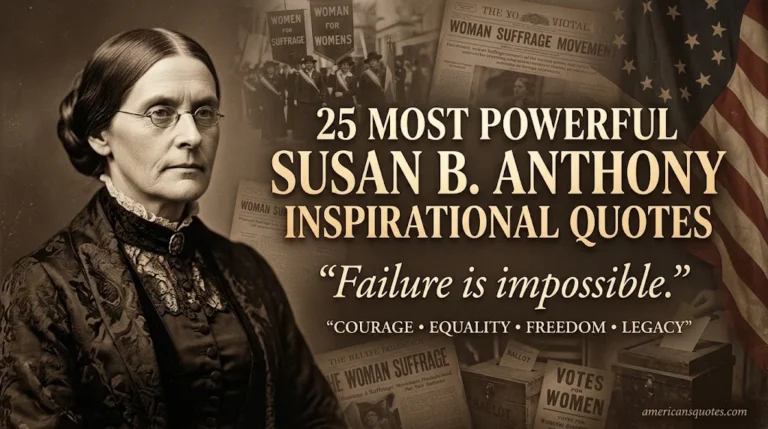
Susan B. Anthony spent more than 50 years fighting for women’s right to vote. Her words still shape talks about equal pay, independence, and voting rights in the United States.
This post shares the most famous Susan B. Anthony quotes, each with a short note on where it came from. We left out popular lines with no solid source, so every quote here is safe to share.
Table of Contents
Who Was Susan B. Anthony? Life and Legacy Behind Her Famous Quotes
Knowing her story makes her famous quotes hit harder. Here are the key facts.
Susan Brownell Anthony was born on February 15, 1820, in Adams, Massachusetts. She grew up in a Quaker family that opposed slavery. Her father, Daniel Anthony, ran a cotton mill.
The family moved to Rochester, New York, in 1845. There, they met Frederick Douglass and William Lloyd Garrison. A temperance meeting once refused to let her speak because she was a woman. That moment pushed her toward women’s rights.
In 1869, she and Elizabeth Cady Stanton founded the National Woman Suffrage Association. Together, they also ran a weekly paper, The Revolution.
In 1872, Anthony voted in a presidential election. She was arrested, tried in 1873, and fined $100. She never paid it. She died on March 13, 1906, at age 86. The 19th Amendment passed 14 years later, in 1920. People call it the Susan B. Anthony Amendment.
Famous Susan B. Anthony Quotes on Women’s Suffrage and Voting Rights
These Susan B. Anthony suffrage quotes show why she saw the ballot as the key to every other right.
Men, their rights, and nothing more; women, their rights, and nothing less.
Context: The motto of her newspaper, The Revolution, in 1868.
There never will be complete equality until women themselves help to make laws and elect lawmakers.
Context: Her reason for moving from temperance work to the fight for the vote.
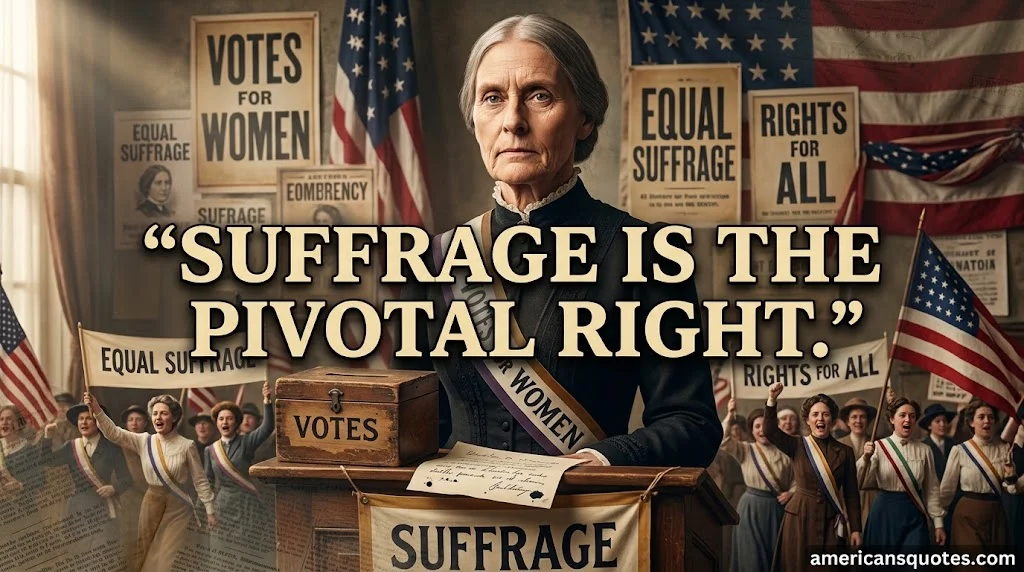
Suffrage is the pivotal right.
Context: Her belief that voting protects every other right.
It was we, the people; not we, the white male citizens; nor yet we, the male citizens; but we, the whole people, who formed the Union.
Context: From her speech “Is It a Crime to Vote?” after her 1872 arrest.
The only question left to be settled now is: Are women persons?
Context: Her key point in that same speech.
Being persons, then, women are citizens; and no state has a right to make any new law, or to enforce any old law, that shall abridge their privileges or immunities.
Context: Her 14th Amendment argument for why women could legally vote.
How can “the consent of the governed” be given if the right to vote be denied?
Context: Her reading of the Declaration of Independence.
It is downright mockery to talk to women of their enjoyment of the blessings of liberty while they are denied the use of the only means of securing them provided by this democratic-republican government: the ballot.
Context: She argued that liberty means little without a vote.
Women, we might as well be dogs baying the moon as petitioners without the right to vote!
Context: A blunt warning that asking politely gets nowhere without voting power.
No man is good enough to govern any woman without her consent.
Context: Her take on self-rule and the consent of the governed.
Resistance to tyranny is obedience to God.
Context: An old Revolutionary saying she urged women to adopt.
Resolved, that the women of this nation in 1876, have greater cause for discontent, rebellion and revolution than the men of 1776.
Context: From 1876, when she compared women’s fight to the American Revolution.
Wherever, on the face of the globe or on the page of history, you show me a disfranchised class, I will show you a degraded class of labor.
Context: She tied the right to vote to fair work and wages.
No self-respecting woman should wish or work for the success of a party who ignores her sex.
Context: Her view that parties must earn women’s support.
Susan B. Anthony Quotes on Equality, Independence, and Equal Pay
Anthony saw money and freedom as linked. These quotes on women’s equality show how she pushed for economic independence.
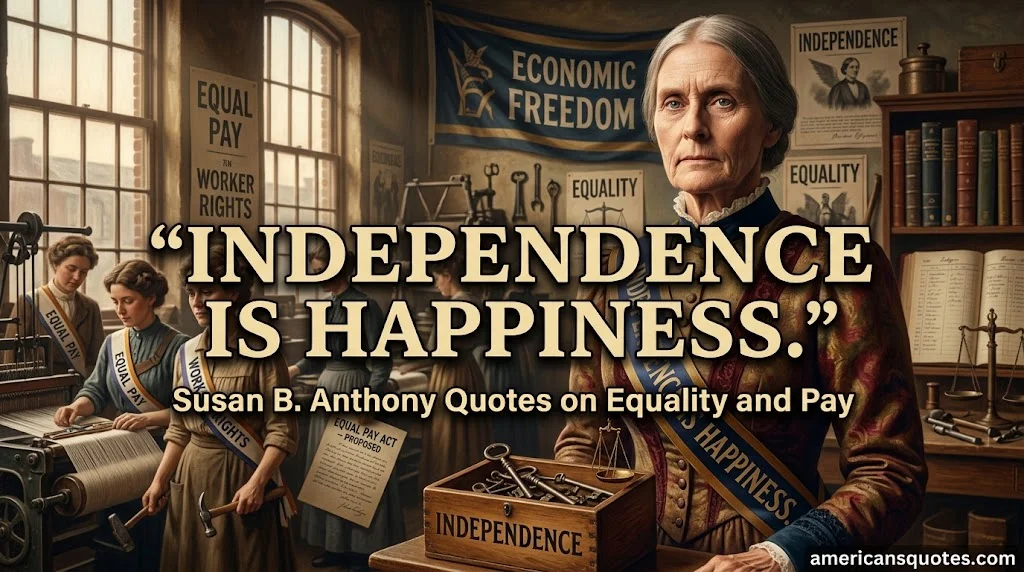
Independence is happiness.
Context: Her shortest and most repeated line on self-reliance.
I declare to you that woman must not depend upon the protection of man, but must be taught to protect herself, and there I take my stand.
Context: A core statement of women’s self-sufficiency.
I think the girl who is able to earn her own living and pay her own way should be as happy as anybody on earth. The sense of independence and security is very sweet.
Context: Her case for women earning their own money.
There is not a woman born who desires to eat the bread of dependence.
Context: Her point that needing someone for money gives that person power.
Join the union, girls, and together say Equal Pay for Equal Work.
Context: Her support for women workers who organized.
I do not demand equal pay for any women save those who do equal work in value.
Context: Her view that pay should match the value of the work.
Whoever controls work and wages, controls morals.
Context: Why money sat at the center of her campaign.
Marriage, to women as to men, must be a luxury, not a necessity; an incident of life, not all of it.
Context: She never married, and she criticized the marriage laws of her day.
Let me tell you what I think of bicycling. I think it has done more to emancipate women than anything else in the world.
Context: From an 1896 interview, when bicycles gave women new freedom.
I do not assume that woman is better than man. I do assume that she has a different way of looking at things.
Context: Why women’s voices belong in lawmaking.
Modern invention has banished the spinning wheel, and the same law of progress makes the woman of today a different woman from her grandmother.
Context: How new technology changed women’s roles.
The principle of self-government cannot be violated with impunity. The individual’s right to it is sacred, regardless of class, caste, race, color, sex or any other accident or incident of birth.
Context: Her wide view of equal rights for all people.
I look for the day when the only criterion of excellence or position shall be the ability and character of the individual; and this time will come.
Context: Her hope for a world that rewards merit, not gender.
Women should have equal pay for equal work and they should be considered equally eligible to the offices of principal and superintendent, professor and president.
Context: Her push for fair pay and top jobs for women in education.
Inspiring Susan B. Anthony Quotes on Courage, Justice, and Legacy
Her most inspiring quotes come from her toughest years. They speak of perseverance, conscience, and the work left unfinished.
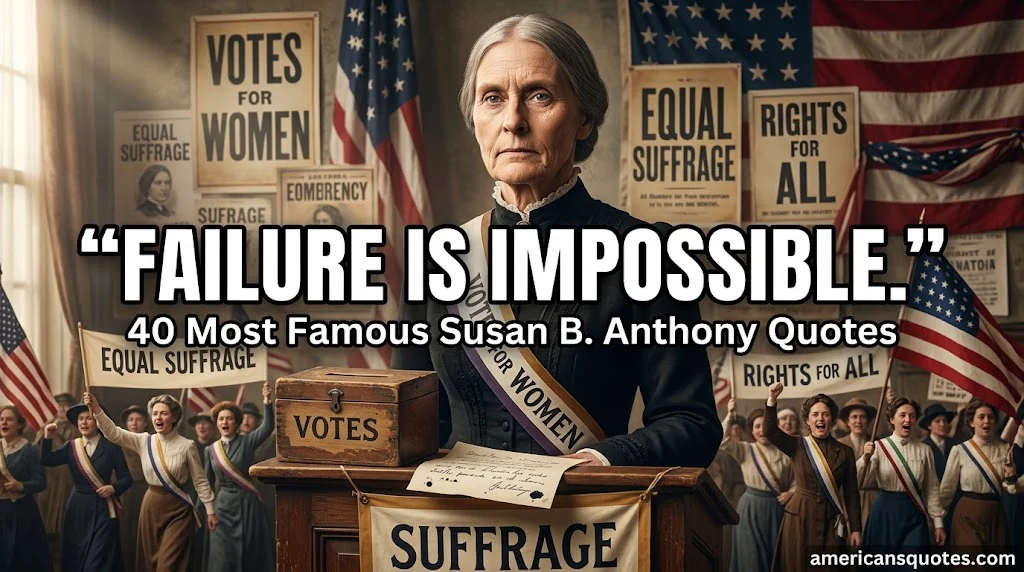
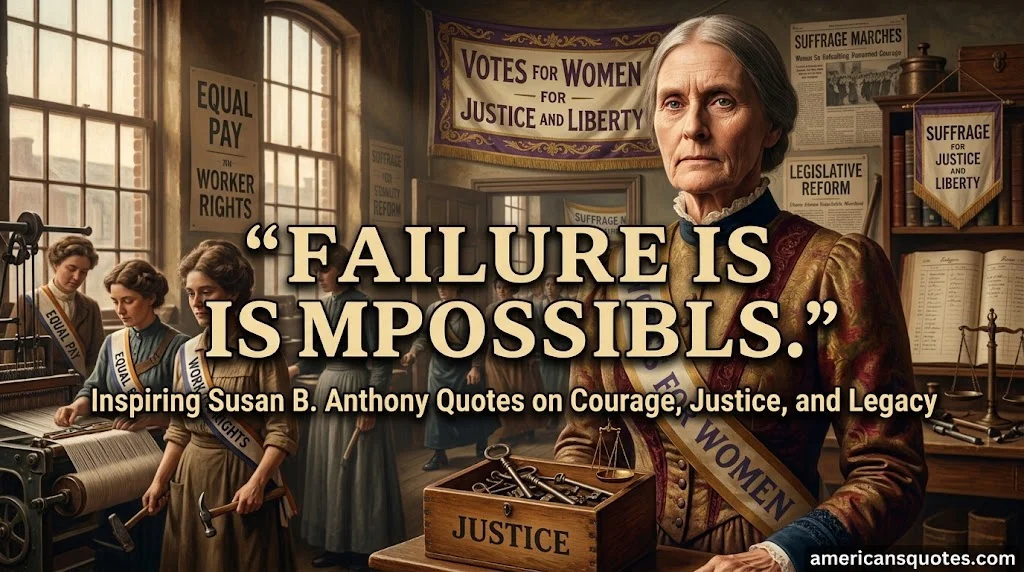
Failure is impossible.
Context: Her best-known motto, said at her 86th birthday event in Washington, D.C., in 1906.
Organize, agitate, educate, must be our war cry.
Context: Her call to build the movement step by step.
Forget conventionalisms; forget what the world thinks of you stepping out of your place; think your best thoughts, speak your best words, work your best works, looking to your own conscience for approval.
Context: Her advice to act on conscience, not public approval.
Cautious, careful people, always casting about to preserve their reputations, can never effect a reform.
Context: Her view that real change needs bold people.
I distrust those people who know so well what God wants them to do because I notice it always coincides with their own desires.
Context: Her warning, shaped by her Quaker roots, about those who claim to speak for God.
Trust me that as I ignore all law to help the slave, so will I ignore it all to protect an enslaved woman.
Context: Rooted in her years of abolitionist work.
I will cut off this right arm of mine before I will ever work or demand the ballot for the Negro and not the woman.
Context: From the 1860s fight over the 15th Amendment, which split her from Frederick Douglass.
The older I get, the greater power I seem to have to help the world; I am like a snowball, the further I am rolled the more I gain.
Context: Her thoughts on staying active late in life.
I don’t want to die as long as I can work; the minute I cannot, I want to go.
Context: Her devotion to the cause until the end.
Oh, if I could but live another century and see the fruition of all the work for women! There is so much yet to be done.
Context: Her hope near the end of her life.
To think, I have had more than 60 years of hard struggle for a little liberty, and then to die without it seems so cruel.
Context: Her sadness that women still could not vote.
I pray every single moment of my life; not on my knees but with my work. My prayer is to lift women to equality with men.
Context: How she tied her faith to her daily work.
FAQs
What is Susan B. Anthony’s most famous quote?
Her most famous quote is her 1868 motto for The Revolution.
Men, their rights, and nothing more; women, their rights, and nothing less.
Her motto “Failure is impossible” is a close second.
What is the most inspiring quote about women’s suffrage?
Many point to her line on equality and lawmaking: “There never will be complete equality until women themselves help to make laws and elect lawmakers.” Other favorites are “Suffrage is the pivotal right” and “Organize, agitate, educate.”
What is Susan B. Anthony most famous for?
She is most famous for leading the women’s suffrage movement in the United States. She co-founded the National Woman Suffrage Association, voted in 1872, and stood trial in 1873. The 19th Amendment was nicknamed for her, and she became the first woman on a circulating U.S. coin in 1979. Read the amendment’s story at the National Archives.
Was Susan B. Anthony LGBTQ?
She never married and had close friendships with women, and some historians discuss those bonds. Beyond that, any claim is guesswork.
What were Susan B. Anthony’s last words?
No single “last words” line is firmly recorded. Her best-known final public words are “Failure is impossible,” spoken at her 86th birthday in 1906. She died on March 13, 1906, in Rochester, New York, from heart failure and pneumonia.
Conclusion
Susan B. Anthony never saw women vote, yet her words carried the cause to the finish line. These famous Susan B. Anthony quotes still remind us that equal rights take patience, courage, and organizing. Which of her quotes speaks to you most?
Vicky ABROY is a writer, editorial curator, and lead researcher for AmericansQuotes.com. With a deep appreciation for the power of language, Vicky specializes in documenting, analyzing, and contextualizing iconic American speeches, literary excerpts, and historical quotations. Through meticulous research and engaging commentary, Vicky highlights the voices that have defined American thought, culture, and leadership across generations—helping readers discover the timeless wisdom hidden within famous words.