Susan B. Anthony quotes about change still push people to act. She spent over 50 years fighting for women’s suffrage, equal pay and civil rights. Her words were short, bold and built for action.
Anthony was born in 1820 and died in 1906. She never saw the 19th Amendment pass. It was ratified in 1920, and people called it the Susan B. Anthony Amendment. Here are 35 Susan B. Anthony quotes about change, grouped by theme and tied to the moment she said them.
Table of Contents
Susan B. Anthony Quotes About Change and Social Reform
These quotes show how Anthony saw reform. She asked people to organize, take risks and stay bold.
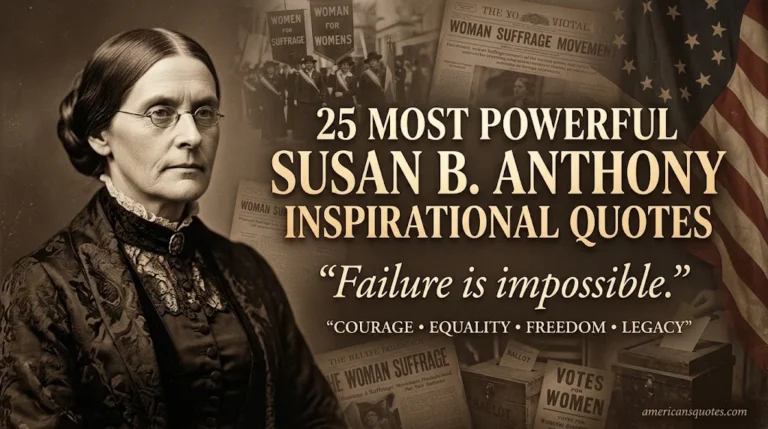
Failure is impossible.
She said this at her 86th birthday event in Washington, D.C., in 1906. It was her last public speech.
Organize, agitate, educate, must be our war cry.
This war cry is tied to her work at The Revolution, the weekly paper she backed in the late 1860s.
Resistance to tyranny is obedience to God.
She called this an old revolutionary maxim when she defended her 1872 vote.
Cautious, careful people, always casting about to preserve their reputation and social standing, never can bring about a reform.
She wrote this in 1860, during her divorce law reform campaign.
Those who are really in earnest must be willing to be anything or nothing in the world’s estimation.
This is from the same 1860 passage. It asks reformers to risk their public image.
I distrust those people who know so well what God wants them to do, because I notice that it always coincides with their own desires.
She said this in a 1896 address to the National American Woman Suffrage Association.
I got petitions signed for property laws and for suffrage.
She told journalist Nellie Bly this in 1896. It shows her grassroots organizing.
I think it has done more to emancipate women than anything else in the world.
She was talking about the bicycle in a 1896 interview. Bikes gave women freedom of movement.
She’ll be free. Then she’ll be whatever her best judgment wants to be.
This is her answer about the “new woman” in the same 1896 interview.
Governments cannot afford to ignore the rights of those holding the ballot, who make and unmake every law and law-maker.
It comes from her 1878 speech, “Woman Wants Bread, Not the Ballot!”
I do not care where we stand with the women! We have been getting them for fifty years. We are after the men now.
She told a House Judiciary Committee this in January 1896. Only men could vote then.
We have known how to make the noise, you see, and how to bring the whole world to our organization in spirit, if not in person.
She spoke at the 1893 World’s Congress of Representative Women in Chicago.
Susan B. Anthony’s powerful words remind us that meaningful change begins with courage, determination, and the willingness to challenge injustice. Explore these Susan B. Anthony inspirational quotes to find more motivation to stand up for equality, embrace change, and make a lasting difference.
Susan B. Anthony Quotes About Women’s Rights and Equality
Anthony tied gender equality to one tool: the ballot. These quotes show why.
Men, their rights and nothing more; women, their rights and nothing less.
This was the motto of The Revolution. It sums up her view of equal rights.
Join the union, girls, and together say, Equal Pay for Equal Work.
She urged women to organize for equal pay in 1869. Teachers and printers were her main audience.
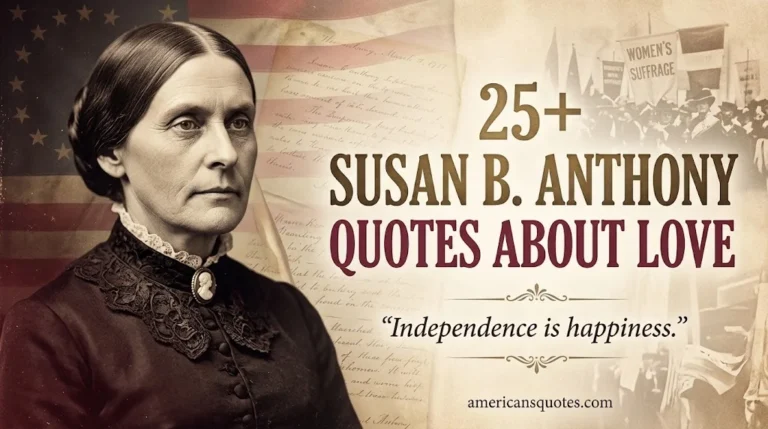
Independence is happiness.
Three words, and a clear view of why economic independence mattered to her.
It was we, the people; not we, the white male citizens; nor yet we, the male citizens; but we, the whole people, who formed the Union.
She gave this speech in 1873 after her arrest for voting in Rochester, New York.
It is downright mockery to talk to women of their enjoyment of the blessings of liberty while they are denied the use of the only means of securing them provided by this democratic-republican government—the ballot.
It comes from the same 1873 speech. Her case rested on the Fourteenth Amendment.
Marriage, to women as to men, must be a luxury, not a necessity; an incident of life, not all of it.
She said this in her 1875 “Social Purity” speech in Chicago.
That equality of rights and privileges is vested in the ballot, the symbol of power in a republic.
It is from the same 1875 speech. For her, the right to vote unlocked every other right.
It is not because the members of Congress are tyrants that women receive only half pay and are admitted only to inferior positions in the departments.
She spoke about the gender pay gap in her 1878 address.
The prejudice against color, existing in the minds of the white people of this country, is no stronger than that against sex.
She linked abolition and women’s rights in an 1860 address.
Here, in this first paragraph of the Declaration, is the assertion of the natural right of all to the ballot; for, how can “the consent of the governed” be given, if the ballot be denied?
She used the Declaration of Independence to argue for the vote in 1873.
We assert the province of government to be to secure the people in the enjoyment of their unalienable rights. We throw to the winds the old dogma that governments can give rights.
She argued that rights are natural, not granted by the state.
The only question left to be settled, now, is: Are women persons?
This is her sharpest legal question from the 1872–1873 speeches. It frames women’s citizenship in one line.
Susan B. Anthony Quotes About Courage, Action and Perseverance
Anthony took real risks for her beliefs. These quotes show her courage and perseverance.
May it please your honor, I shall never pay a dollar of your unjust penalty.
She said this in June 1873. The judge had fined her $100 for illegal voting, and she never paid.
I will prove to you that in thus voting, I not only committed no crime, but, instead, simply exercised my citizen’s right, guaranteed to me and all United States citizens by the National Constitution, beyond the power of any State to deny.
She spoke these words in 1873, before her trial. The full speeches are online.
There is great fear expressed on all sides lest this war shall be made a war for the negro. I am willing that it shall be.
She said this in 1863, during the Civil War. It shows her abolitionist roots.
Hence, our first and most urgent demand—that women shall be protected in the exercise of their inherent, personal, citizen’s right to a voice in the government, municipal, state, national.
This is a call to action from her 1875 speech.
Our faith is firm and unwavering in the broad principles of human rights proclaimed in 1776, not only as abstract truths, but as the corner stones of a republic.
Yet we cannot forget, even in this glad hour, that while all men of every race, and clime, and condition, have been invested with the full rights of citizenship under our hospitable flag, all women still suffer the degradation of disfranchisement.
It comes from the same 1876 declaration. She read it uninvited from the platform.
It is simply in obedience to a law of political economy, which makes it impossible for a government to do as much for the disenfranchised as for the enfranchised.
Here she explains why the vote gives political power in her 1878 speech.
Hence, every discrimination against women in the constitutions and laws of the several states, is to-day null and void, precisely as is every one against negroes.
She argued this in 1873. It rests on equal protection under the law.
It is because women have been taught always to work for something else than their own personal freedom.
She explained in 1893 why it was hard to organize women around their own rights.
I had barked up the temperance tree, and I’d barked up the teachers’ tree and I couldn’t do anything.
She told Nellie Bly this in 1896. Temperance and teacher pay taught her that the vote came first.
You are not laughing at me; you are treating me respectfully, because you are hearing my argument; you are not asleep, not one of you, and I am delighted.
She answered a Judiciary Committee in 1880 after the men laughed at her story. She stayed calm.
FAQs
What Are the Most Powerful Susan B. Anthony Quotes About Change?
Her lines on failure being impossible, on organizing and agitating, and on resisting tyranny are the best known. Her 1873 line about “we, the whole people” is also strong. Each one is short and made for action.
How Did Susan B. Anthony Inspire Change Through Her Words?
She gave hundreds of speeches and wrote countless letters. She co-founded the National Woman Suffrage Association with Elizabeth Cady Stanton in 1869. Her trial in 1873 also put women’s suffrage in the news.
What Do Susan B. Anthony Quotes Teach Us About Social Change and Equality?
They teach that rights need legal power. She believed the ballot made all other change possible. She also showed that social change needs organizing, patience and courage.
Which Susan B. Anthony Quotes About Change Inspire Women’s Rights Today?
Her quotes on equal pay, independence and equal rights still guide debates today. Her line about men’s rights and women’s rights, nothing more and nothing less, is a common one. Her call for equal pay is also widely repeated.
How Can Susan B. Anthony Quotes About Change Motivate You to Make a Difference?
Pick one quote and turn it into one small act. You can vote, sign a petition, join a group or speak up at work. Her life shows that steady action beats waiting.
Conclusion
Susan B. Anthony proved that words can start real change. She faced arrest, a fine and years of rejection, and she kept going. Choose one quote from this list and act on it this week.
Vicky ABROY is a writer, editorial curator, and lead researcher for AmericansQuotes.com. With a deep appreciation for the power of language, Vicky specializes in documenting, analyzing, and contextualizing iconic American speeches, literary excerpts, and historical quotations. Through meticulous research and engaging commentary, Vicky highlights the voices that have defined American thought, culture, and leadership across generations—helping readers discover the timeless wisdom hidden within famous words.