Frederick Douglass quotes still shape how Americans talk about freedom, justice, and self-respect today. Below you’ll find 75 of his most famous lines, grouped by theme, with plain-language context for each one so you understand exactly what he meant and why it still matters.
Every quote below is presented exactly as Douglass wrote or spoke it, so you can copy and share it with confidence.
Table of Contents
Who Was Frederick Douglass
Frederick Douglass was born into slavery in Maryland around 1818. He taught himself to read in secret, escaped to freedom in 1838, and went on to become the most famous abolitionist orator in American history. He wrote three autobiographies, ran the anti-slavery newspaper The North Star, and advised presidents on civil rights and emancipation.
His words carry weight because he lived every idea he wrote about. He wasn’t a scholar guessing at what freedom felt like, he was a man who had been denied it and fought to win it back, word by word, speech by speech. That lived experience is why Frederick Douglass quotes on freedom, education, and justice still hit differently than most historical quotations.
Famous Frederick Douglass Quotes on Freedom, Struggle & Progress
This is the heart of Douglass’s message: freedom is never given freely. It has to be demanded, fought for, and defended. These quotes about freedom and progress are the most widely shared Frederick Douglass quotes online, and for good reason, they’re direct, they’re bold, and they still apply to modern fights for justice.
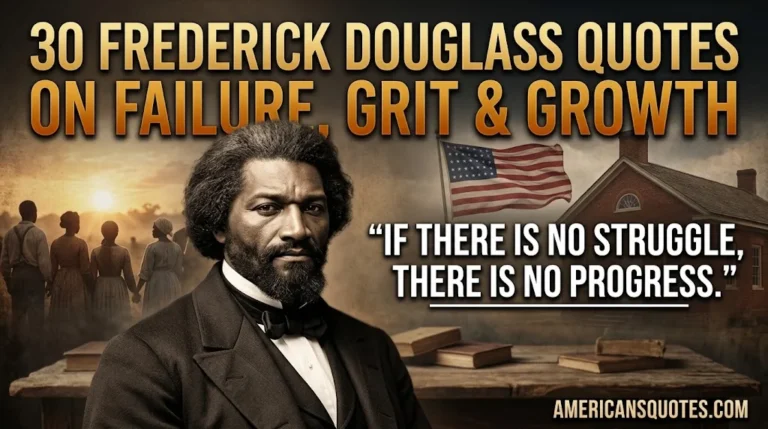
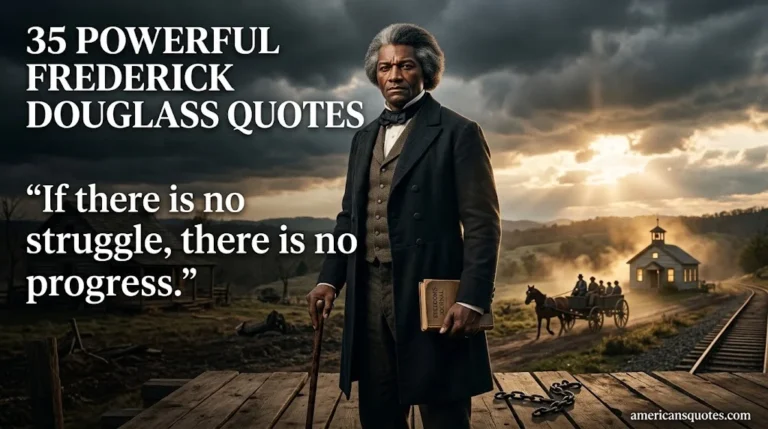
If there is no struggle, there is no progress.
Power concedes nothing without a demand. It never did and it never will.
Those who profess to favor freedom, and yet deprecate agitation, are men who want crops without plowing up the ground. They want rain without thunder and lightning.
Freedom is a road seldom traveled by the multitude.
Our destiny is largely in our hands.
My hopes were never brighter than now.
Douglass often connected personal willpower to national change. He believed a country only moves forward when its people refuse to sit still.
The silver trump of freedom roused in my soul eternal wakefulness.
My long-crushed spirit rose, cowardice departed, bold defiance took its place; and I now resolved that, however long I might remain a slave in form, the day had passed forever when I could be a slave in fact.
I had reached the point, at which I was not afraid to die. This spirit made me a Freeman in fact, while I remained a slave in form.
I didn’t know I was a slave until I found out I couldn’t do the things I wanted.
You will be free as soon as you are twenty-one, but I am a slave for life! Have not I as good a right to be free as you have?
These lines describe the exact moment his mindset shifted, the instant he stopped accepting captivity as permanent. It’s a pattern psychologists still study today: the point where a person decides their circumstances don’t define their worth.
He who despairs of progress despises the hope of the world, and shuts himself out from the chief significance of assistance, and is dead while he lives.
Inaction is followed by stagnation. Stagnation is followed by pestilence and pestilence is followed by death.
The man who will get up will be helped up; and the man who will not get up will be allowed to stay down.
For no man who lives at all lives unto himself. He either helps or hinders all who are in anywise connected to him.
We have to do with the past only as we can make it useful to the present and the future.
He also warned Americans not to get comfortable. Complacency, in his view, was as dangerous as tyranny itself.
As a people, Americans are remarkably familiar with all facts which make in their own favor.
Slavery is indeed gone, but its shadow still lingers over the country and poisons more or less the moral atmosphere of all sections of the republic.
Such are the limitations of the common mind, and so thoroughly engrossing are the cares of common life, that only the few among men can discern through the glitter and dazzle of present prosperity the dark outlines of approaching disasters.
A man’s rights rest in three boxes. The ballot-box, the jury-box, and the cartridge-box.
His speeches often ended with a call for civic participation, voting, jury duty, and standing up for one’s own rights, not waiting for someone else to grant them.
The man who is right is a majority. He who has God and conscience on his side, has a majority against the universe.
One and God make a majority.
A gentleman will not insult me, and no man not a gentleman can insult me.
Frederick Douglass Quotes on Education & Knowledge
Douglass taught himself to read using scraps of newspaper and by trading bread for lessons with poor white children in the street. He treated literacy as the single most powerful weapon against oppression, and his quotes about education reflect that belief clearly.
Once you learn to read, you will be forever free.
Knowledge makes a man unfit to be a slave.
Education means emancipation. It means light and liberty. It means the uplifting of the soul of man into the glorious light of truth, the light by which men can only be made free.
Some know the value of education by having it. I know its value by not having it.
He wasn’t speaking in theory. Slaveholders in his era made it illegal to teach enslaved people to read, precisely because they understood what Douglass understood: an educated mind cannot be permanently controlled.
I have found that, to make a contented slave, it is necessary to make a thoughtless one.
My natural elasticity was crushed, my intellect languished, the disposition to read departed, the cheerful spark that lingered about my eye died; the dark night of slavery closed in upon me; and behold a man transformed into a brute.
A man is worked upon by what he works on. He may carve out his circumstances, but his circumstances will carve him out as well.
From apparently the basest metals we have the finest toned bells.
Men talk much of a new birth. The fact is fundamental. But the mistake is in treating it as an incident which can only happen to a man once in a lifetime.
Douglass also connected education to free speech. He believed the two were inseparable, knowledge without the freedom to express it is useless.
To suppress free speech is a double wrong. It violates the rights of the hearer as well as those of the speaker. It is just as criminal to rob a man of his right to speak and hear as it would be to rob him of his money.
Liberty is meaningless where the right to utter one’s thoughts and opinions has ceased to exist. That, of all rights, is the dread of tyrants. It is the right which they first of all strike down.
Give me the making of a nation’s ballads and I care not who has the making of its Laws.
Frederick Douglass Quotes on Justice, Equality & Christianity
Douglass built his reputation on holding America to its own stated ideals. His quotes about justice and equality are blunt, and his views on Christianity were sharply split: he separated the actual teachings of Christ from how slaveholders twisted religion to justify slavery.
Right is of no sex, Truth is of no color, God is the Father of us all, and we are all Brethren.
Find out just what any people will quietly submit to and you have the exact measure of the injustice and wrong which will be imposed on them.
The American people have this to learn: that where justice is denied, where poverty is enforced, where ignorance prevails, and where any one class is made to feel that society is an organized conspiracy to oppress, rob, and degrade them, neither person nor property is safe.
A man who will enslave his own blood, may not be safely relied on for magnanimity.
There is not a man beneath the canopy of heaven, that does not know that slavery is wrong for him.
His most quoted statement on faith drew a hard line between true Christianity and the version practiced by slaveholders:
To be the friend of the one, is of necessity to be the enemy of the other. I love the pure, peaceable, and impartial Christianity of Christ: I therefore hate the corrupt, slaveholding, women-whipping, cradle-plundering, partial and hypocritical Christianity of this land.
I am opposed to war, because I am a believer in Christianity. I believe, if there is one thing more than another that has brought reproach upon the Christian religion, it is the spirit of war.
Douglass also spoke directly to America’s contradictions between its founding principles and its treatment of enslaved people, most famously in his Fourth of July address:
What, to the American slave, is your 4th of July? I answer: a day that reveals to him, more than all other days in the year, the gross injustice and cruelty to which he is the constant victim.
No, I make no pretension to patriotism. So long as my voice can be heard on this or the other side of the Atlantic, I will hold up America to the lighting scorn of moral indignation. In doing this, I shall feel myself discharging the duty of a true patriot; for he is a lover of his country who rebukes and does not excuse its sins.
The best friend of a nation is he who most faithfully rebukes her for her sins, and her worst enemy who, under the specious garb of patriotism, seeks to excuse, palliate, or defend them.
The feeling of the nation must be quickened; the conscience of the nation must be roused; the propriety of the nation must be startled; the hypocrisy of the nation must be exposed; and its crimes against God and man must be denounced.
Slavery, in his telling, corrupted moral responsibility for everyone involved, not just the enslaved.
The morality of free society can have no application to slave society. Make a man a slave, and you rob him of moral responsibility. Freedom of choice is the essence of all accountability.
Reader! Are you with the man-stealers in sympathy and purpose, or on the side of their down-trodden victims? If with the former, then you are the foe of God and man.
Alas! I had not then learned the measure of man’s inhumanity to man, nor to what limitless extent of wickedness he will go for the love of gain.
At this moment, I saw more clearly than ever the brutalizing effects of slavery upon the slave and slaveholder.
When I think that these precious souls are to-day shut up in the prison-house of slavery, my feelings overcome me.
He also spoke to universal human dignity and conscience as the foundation of any just society.
Conscience is, to the individual soul, and to society, what the law of gravitation is to the universe. It holds society together; it is the basis of all trust and confidence.
A man without force, is without the essential dignity of humanity. Human nature is so constituted, that it cannot honor a helpless man, although it can pity him.
I esteem myself a good, persistent hater of injustice and oppression, but my resentment ceases when they cease, and I have no heart to visit upon children the sins of their fathers.
They are always ready to sacrifice, but seldom to show mercy.
Truth shines with brighter light and intenser heat at every moment, and a country torn and rent and bleeding implores relief from its distress and agony.
Frederick Douglass Quotes on Children & Family
Slavery tore apart families deliberately, and Douglass wrote about this loss with real pain. His quotes about children and family are some of his most personal and most quoted lines today, especially in education and parenting circles.
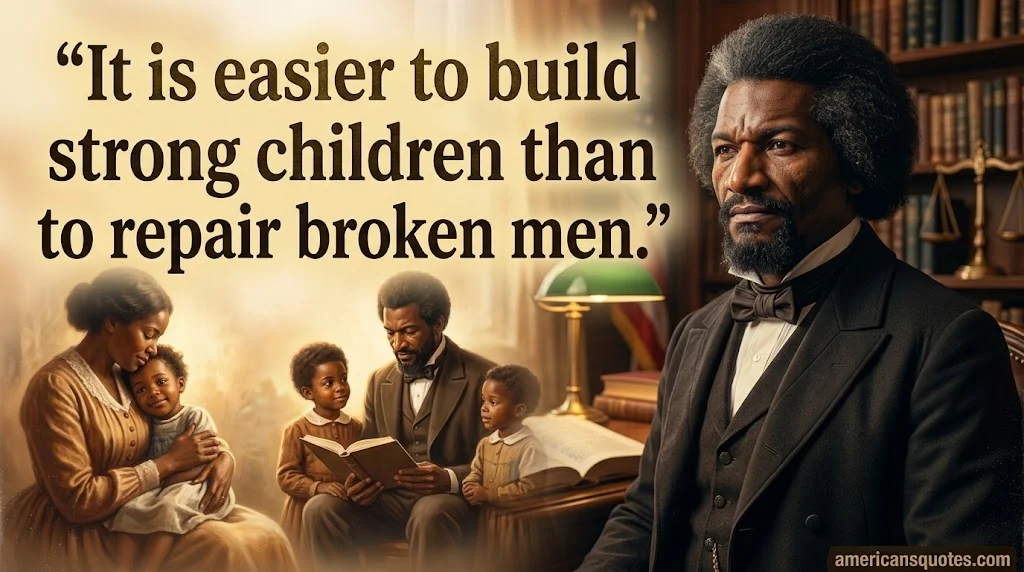
It is easier to build strong children than to repair broken men.
This single line is now one of the most shared Frederick Douglass quotes in the country, parents, teachers, and coaches use it constantly because it captures a simple truth: early guidance prevents future damage.
There is not, beneath the sky, an enemy to filial affection so destructive as slavery. It had made my brothers and sisters strangers to me.
America will not allow her children to love her. She seems bent on compelling those who would be her warmest friends, to be her worst enemies.
But I should be false to the earliest sentiments of my soul, if I suppressed the opinion. I prefer to be true to myself, even at the hazard of incurring the ridicule of others, rather than to be false, and incur my own abhorrence.
I have often been asked how I felt when first I found myself on free soil. There is scarcely anything in my experience about which I could not give a more satisfactory answer. A new world had opened upon me.
I was in the midst of an ocean of my fellow-men, and yet a perfect stranger to every one.
Reason is imprisoned here, and passions run wild. Like the fires of the prairie, once lighted, they are at the mercy of every wind.
Mankind differs as the waves, but they are one as the sea.
Immense wealth, and its lavish expenditure, fill the great house with all that can please the eye, or tempt the taste. Here, appetite, not food, is the great desideratum.
The singing of a man cast away upon a desolate island might be as appropriately considered as evidence of contentment and happiness, as the singing of a slave.
The thought of only being a creature of the present and past was troubling. I longed for a future too, with hope in it. The desire to be free, awakened my determination to act, to think, and to speak.
They are thought pictures, the outstanding headlands of the meandering shores of life, and are points to steer by on the broad sea of thought and experience.
FAQs
What are the most famous Frederick Douglass quotes?
The most widely shared lines include “If there is no struggle, there is no progress,” “Power concedes nothing without a demand,” and “It is easier to build strong children than to repair broken men.” These three appear most often in books, speeches, and classrooms across the USA.
What did Frederick Douglass say about Christianity?
He drew a sharp line between the real teachings of Christ and the twisted version used to justify slavery, stating: “I love the pure, peaceable, and impartial Christianity of Christ: I therefore hate the corrupt, slaveholding, women-whipping, cradle-plundering, partial and hypocritical Christianity of this land.”
What were some of Frederick Douglass’ most famous quotes about children?
His best-known line on children is “It is easier to build strong children than to repair broken men,” still used widely today in education and parenting. He also wrote about how slavery destroyed family bonds, calling it “an enemy to filial affection.”
What is Frederick Douglass’s most famous quote?
Most historians and educators point to “If there is no struggle, there is no progress” as his single most quoted line, since it summarizes his entire philosophy on freedom and change in one sentence.
What did Donald Trump say about Frederick Douglass?
During a 2017 Black History Month event at the White House, Donald Trump referred to Frederick Douglass as someone “who’s done an amazing job and is being recognized more and more,” a comment that drew wide media attention because it implied uncertainty about whether Douglass, who died in 1895, was still alive.
Conclusion
Frederick Douglass spent his life proving that words, backed by action, can outlast chains, laws, and even the men who wrote them. These 75 Frederick Douglass quotes aren’t just historical artifacts, they’re still functional tools for anyone fighting for freedom, education, or basic human dignity today.
Vicky ABROY is a writer, editorial curator, and lead researcher for AmericansQuotes.com. With a deep appreciation for the power of language, Vicky specializes in documenting, analyzing, and contextualizing iconic American speeches, literary excerpts, and historical quotations. Through meticulous research and engaging commentary, Vicky highlights the voices that have defined American thought, culture, and leadership across generations—helping readers discover the timeless wisdom hidden within famous words.